I love history. Much of my library is made up of history book and a significant part biographies. I find the past fascinating and interesting. One of my current hobbies is vintage photography. I make a point to visit vintage shops and look for vintage photos. Recently, I have found some that have caught my attention. Many of these date from 1890’s to early 1900’s originating from the same area in the Pacific Northwest which includes Idaho. In the process I learned a bit about photography during this time. I also went back to what was happening in the United Staes during this time.
Photography was in its infancy, but it was progressing. The photos were black-and-white, sepia (which were more expensive) and often set on heavy card stock. Many of these photos were taken in studios, set in formal poses and required serious demeanors. In the 1900’s Kodak introduced glass plate negatives (role films) and introduced the Brownie camera with the slogan “You Press the Button, We Do the Rest” (available for sale even now) in the 1900’s. This revolutionized photography with people able to take “snapshots” of their daily lives. Prints were 3x5 often in a “crystal finish” which was stamped on the back of photos. Developing still required developing the negatives and many local drugstores (e.g. The Own Drug Company) provided this service.
The “Golden Age” of 4x5 postcards that took place in the 1890’s to about 1915 made correspondence easier. At the end of the 1800’s one cent government-issued post-cards were used but the general printers were allowed to do their own after 1898. Many of these post-cards were illustrated or had pictures of popular places. People, especially average middle class, also took used postcards with pictures of themselves (which were more expensive) and used them to keep people up to date. I planning on a post based on over 40 3x5 “correspondence” postcards to a particular person’s and my findings.
What was happening during this time in the United States? Mark Twain called the time from 1870s to 1890 the Gilded Age. This was a time of transition into the Progressive Era with industrial and economic boom, migration growth, fast urbanization, economic inequality, and technological change (cars became more affordable-$260 especially after Ford’s moving assembly line in 1913). The Progressive Era tried to remedy some of the problems of the Gilded Age through political reform, economic regulation, and moral and social programs. Theodore Roosevelt, William Taft and Woodrow Wilson were the presidents that led the US during this time. In 1913 the passage of the 16th Amendment established a federal income tax. Prior to this, tariffs were the major source of revenue for the United States.
Here is my first batch of photos.
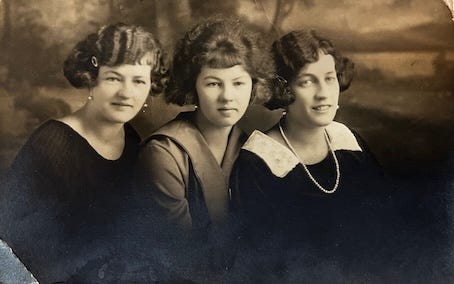
This photo was probably taken in a studio and printed from a glass plate. I called this picture “Three sisters” but of course I am not certain. Their dress and hair style is apparently of the 1920’s. Their hairstyle apparently was “finger wave” a symbol of rebellion. It doesn’t seem to me in this case.
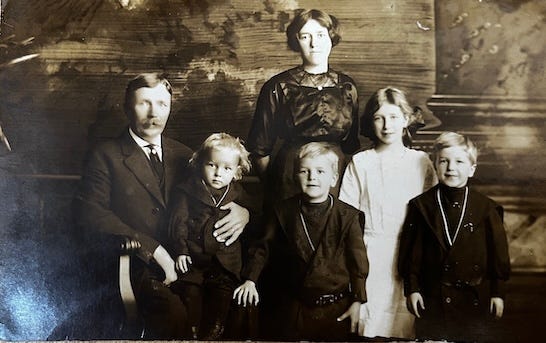
According to my investigation this is the Fredericksen family: Herman Fredericksen, Kingerborg Jensen Fredericksen, their two sons, and two daughters. The parents were Danish. They are formally dressed based on norms back then. Smiling was not considered appropriate. The two boys standing seem to be twins. Another photo, dating about 4 years later of them is featured in “The Portal to Texas History” .
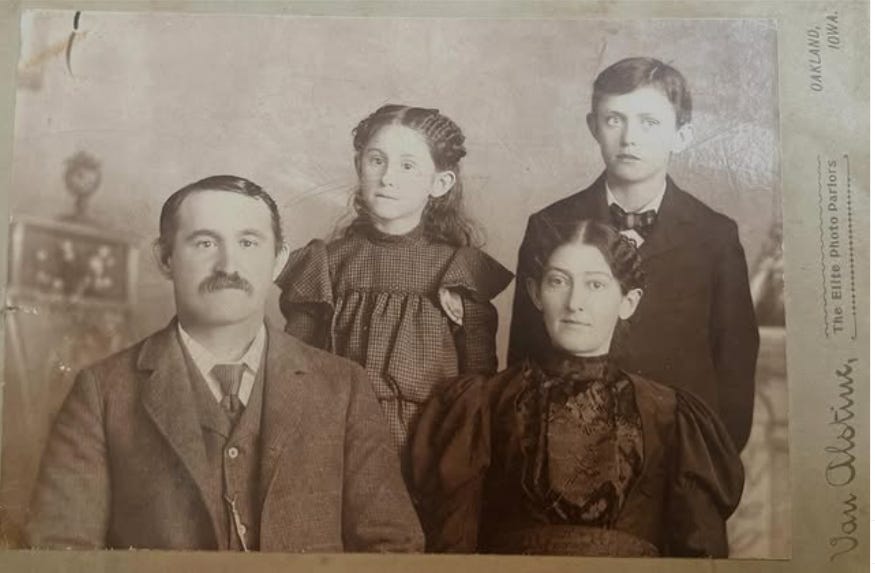
The photograph of this family in Victorian apparel. It was taken by “Van Alstine, The Elite Photo Parlors” which was located in Oakland, Iowa. The picture is sepia tone, on the cardstock, some fading.
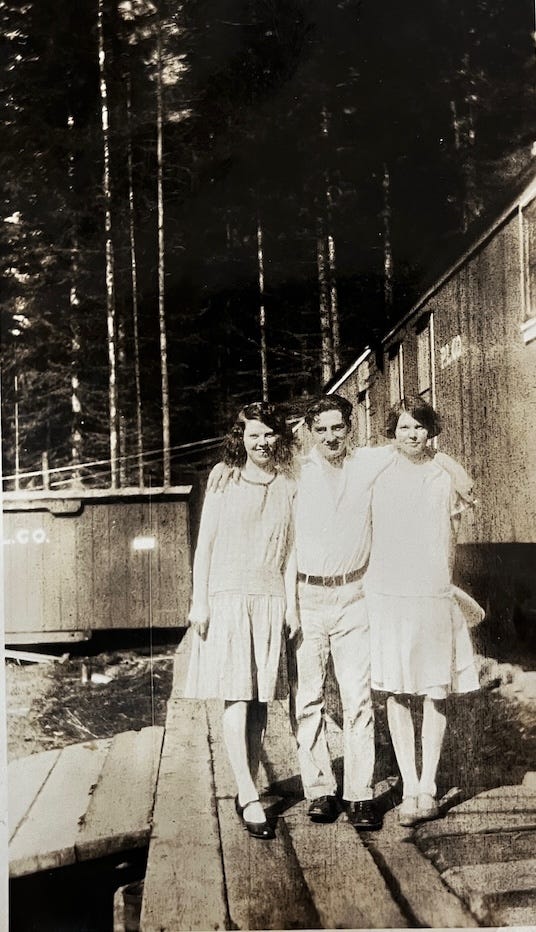
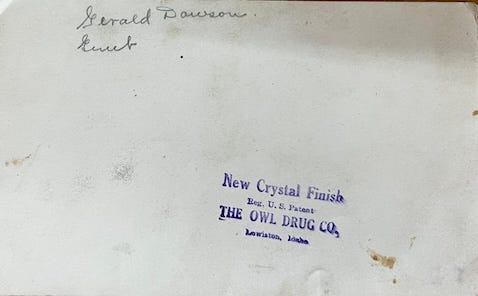
Three friends smiling. This photo is in “New Crystal Finish”, the photographic glossy paper finish available around this time. The back identifies Gerald Dowson, and Ruth possibly in a logging camp in the Pacific Northwest around the 1920s. It also has a stamp from The Owl Drug Co. in Lewiston, Idaho. “THE OWL DRUG CO, Lewiston, Idaho” opened in Lewiston in 1895. still operates today as The Owl Pharmacies in the Lewis-Clark Valley.


No comments:
Post a Comment