The Value of Fathers
Just recently I read a book called “Families and Faith: How Religion is Passed Down Across Generations” that carried out a longitudal study following generations from different religious background since 1970 until 2005. This study is one of its kind[1] offering important findings as it relates to passing on our faith (religion). The study was conducted starting in 1970 and ended in 2005. It involved a multidecade study of four-generation families involving data from more than 3,500 grandparents, parents, grandchildren, and now great-grandchildren. They asked was: “Which types of parenting and styles of religious socialization—for example, religiously firm parenting or religiously open parenting—were most effective in raising children who would follow their parents in faith? Which parenting styles were least successful?”
Here is what they found out:
“But what is really interesting is that, for religious transmission, having a close bond with one’s father matters even more than a close relationship with the mother. Clearly the quality of the child’s relationship with his or her father is important for the internalization of the parent’s religious tradition, beliefs, and practices. Emotional closeness with mothers remains important for religious inheritance but not to the same degree as it is for fathers.”
This was not so surprising to me, but it resonated in my own parenting. I realized some of my own short comings in raising my own children. Three of the four are out of the home, and though I took my role as a father seriously in all aspects I can see how I failed to have a close bond with some of them. With two of my children there were unique circumstances but nevertheless I had ample time and opportunities to create this bond and I believed I failed. I realize that, at least in one of them, this had an effect in her faith. My second oldest has a strong faith. I have one more at home and I have been intentional in developing a close bond with her.
I realize that my shortcomings were due to my own lack of having a father. I have admitted that I am not a good parent, at least not how I should be.
In another post I elaborated on how I needed a father as I was growing up. Here is part of what I wrote then:
Today my father died. Even though he abandoned us when we were children, he is the man God chose to bring me to life. I have never written about it anywhere, but I have always thought about the role of fathers and dads in their children. I have also done a bit of reading about the role of fathers in children’s lives. The conclusion is indisputable (see this here and here). Fathers are important in the lives of their children. I guess that given the choice of a not so good father and no father, I would have chosen to have one. It was not granted to me. I do not hold any anger or resentment, nor do I judge the man who God chose to grant me life. He is certainly giving account to God now (Hebrews 9:27). I am thankful I live, and that God has blessed me with the gift of knowing Him. It has always been very puzzling and disturbing though, how men can walk away from children they willingly conceive and never turn back. I have yet to understand this.
Regardless of my lack of having a father, I take full responsibility in all my shortcomings as a father. I have thought about it many times and wish I could go back and make it better. So, I am striving continue fostering a close relationship with my sixteen-year-old daughter. I believe I am on the right path.
This study also found some things related to the group of Christians I belong:
“Among Evangelicals it is the father–child relationship that is clearly more related to transmission: A 25-point difference separates those who feel close to those who feel distant from their father, while only 1point separates those who feel close to or distant from their mother.”
They also elaborated how Evangelicals focused on their failures (about 40% of children were not following the faith) more than on what they were doing right (about 60% of children kept the faith). This is a very unfortunate perspective.
It is also interesting that grandparents play a significant role in passing on the faith to children:
“Thus, it is not surprising that a majority of grandchildren report being emotionally close to their grandparents, as well as sharing similar views and values with grandparents.”
As grandparents we have an opportunity to influence our grandchildren.
This study also mentioned people who were non-religious and I found this to be interesting:
“In fact, many nonreligious parents were more coherent and passionate about their ethical principles than some of the “religious” parents in our study.”
This book far from being a downer it offers encouragement to parents, grandparents and clergy in how to help families pass on their faith to their generations.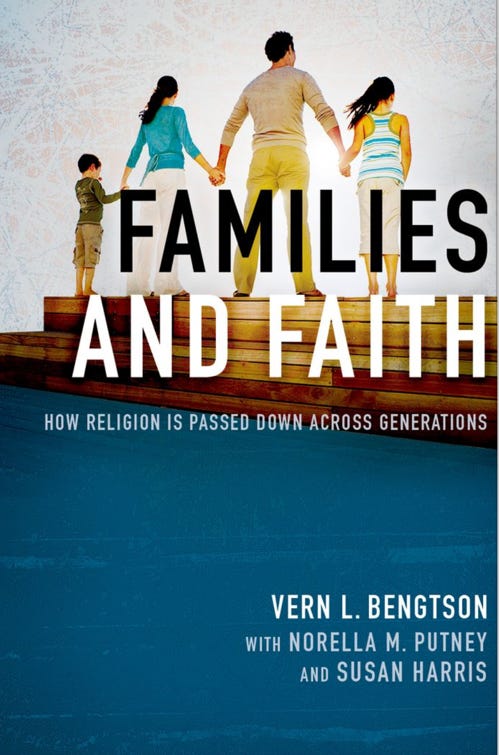
[1] There is another study where 215 families were interviewed in-depth regarding passing on the faith to children. I haven’t had the opportunity to read in the book but hoping to do in the future. The book is called “Handing Down the Faith: How Parents Pass Their Religion on to the Next Generation” by Christian Smith & Amy Adamczyk.


No comments:
Post a Comment